Switching to a tankless water heater is one of the most practical upgrades a homeowner can make for daily comfort and long term savings. Many people think of on demand water heaters as a simple change in appliance, but the differences affect energy use, household routines, space planning, and long term budgets. This article walks through the real world benefits of tankless water heating and gives clear guidance for choosing the right system.
I will include numbers you can use for rough calculations, tips that reduce installation surprises, and examples that explain how a tankless system behaves in busy homes. Read on for a straightforward look at why tankless technology is worth considering and how to evaluate options for your house or small business.
What tankless water heaters are and how they work
Tankless water heaters heat water on demand instead of keeping a storage tank full of hot water. When a tap opens, a flow sensor activates a burner or electric heating elements that bring water to the set temperature. Once the tap closes the unit stops heating.
This on demand approach removes standby heat loss that occurs with storage tanks. It also changes the flow dynamics in a plumbing network, so knowing household hot water patterns matters when you size a system.
Energy savings and cost comparisons with clear examples
One major benefit of tankless water heating is lower energy use over time for many households. The amount depends on fuel type, local rates, and hot water consumption. Here are typical savings patterns that help form realistic expectations.
Example calculation for a family of four
Assume the family uses 64 gallons of hot water per day and has a storage electric tank with a first hour rating that loses heat during idle times. Switching to a gas tankless unit often reduces water heating energy use by 20 percent to 34 percent for families with that level of use. If the yearly water heating bill was twelve hundred dollars, savings could be roughly two hundred forty to four hundred eight dollars per year. Adjust the estimate to match your energy costs and hot water habits.
When savings are smaller
If a household uses very little hot water, or if electric rates are unusually low, the annual savings may be modest. In those scenarios the main gains may be space savings and longer equipment life rather than immediate payback via energy bills.
Endless hot water and handling simultaneous demands
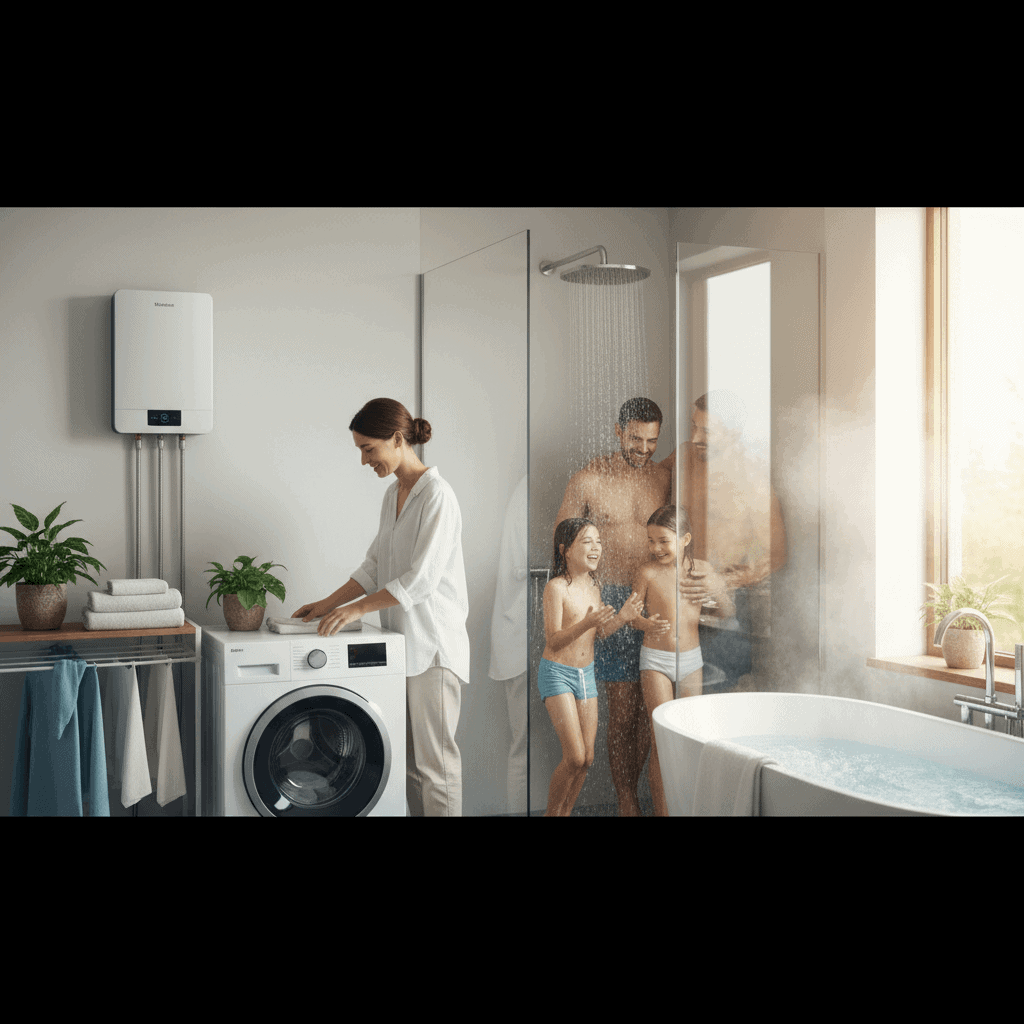
One strong appeal of tankless systems is the practical benefit of near endless hot water. That helps when people run showers, a dishwasher, and a laundry load at the same time. The key limitation is flow rate and temperature rise. A single unit has a maximum gallons per minute rating, and that rating drops as required temperature rise increases.
In a typical home, a tankless unit with a six to eight gallons per minute rating can support a shower and a dishwasher simultaneously if the incoming water temperature is moderate. In colder climates where incoming water is much colder, the same unit will deliver fewer gallons per minute at a set temperature. Understanding your incoming water temperature and peak hot water needs avoids undersizing problems.
Space savings and installation flexibility
Tankless units are compact and mount on a wall, which frees up floor space taken by bulky tanks. That compactness is especially useful in small homes, condos, and utility closets. They also allow installation in more locations because they do not require the floor footprint a tank does.
Installing a tankless unit on an exterior wall can simplify venting and reduce the length of gas or electric runs. However, upgrades to gas lines or electrical service may be needed, so planning matters. Consider the following installation tips.
- Check fuel supply Gas fired units may require larger gas lines or gas pressure adjustments. Have a pro measure supply before committing to a specific model.
- Plan venting carefully Proper venting preserves efficiency and safety. Modern condensing units use PVC venting while traditional high temperature units use stainless steel. Know which your chosen model requires.
- Watch for clearance rules Even though the unit is small, manufacturers set minimum clearances from walls and combustible materials.
Longevity maintenance and reliability
Tankless water heaters typically last longer than storage tanks, with many units having a service life of twenty years when maintained. Storage tank life is often ten to fifteen years. Fewer replacement events reduce the lifetime cost of hot water delivery.
Maintenance for tankless units focuses on preventing scale buildup especially in hard water areas. Flushing the system with a descaling solution once a year or as the manual recommends keeps heat exchangers operating efficiently. A simple schedule and a check of filters and venting annually will keep a unit running well.
Environmental impact and emissions considerations
Lower fuel consumption leads to lower greenhouse gases for households that switch from less efficient systems. Gas fired tankless units also reduce combustion times because heat is produced only when water flows. For electric tankless units, the environmental outcome depends on the power source of the grid. If local electricity comes from renewable sources, an electric tankless heater can be an attractive low carbon option.
Condensing gas tankless models extract extra heat from exhaust gases, increasing thermal efficiency. These units require a drain for condensate but can deliver higher seasonal efficiencies compared with non condensing models. Choosing a condensing unit makes more sense where natural gas is used and where the extra installation requirements are manageable.
Choosing the right system and working with professionals
Picking the correct tankless model requires three pieces of information. First, estimate peak hot water flow in gallons per minute. Second, determine the temperature rise needed, found by subtracting incoming water temperature from desired hot water temperature. Third, match those numbers to a model that can deliver the flow at the required temperature rise.
When it is time to install, consulting local service providers reduces common mistakes such as undersized gas lines or inadequate venting. If you want a local recommendation for service and installation, check out trusted tankless water heater contractors such as tankless water heater experts who evaluate load calculations, ventilation needs, and permit requirements.
Questions to ask before hiring
- Can the installer run a flow based load calculation for my home
- Will upgrades to gas or electrical service be needed
- What model and warranty do you recommend for my climate and water hardness
- Do you provide post installation testing and a startup checklist
When to consider multiple units
Large households or two story homes with distant bathrooms sometimes use two or more tankless units to avoid long pipe runs and hot water lag. Using multiple units can also provide redundancy so that if one unit needs service, the other continues to supply hot water.
Common myths and practical truths
There are a few persistent myths worth clearing up. One is that tankless units are always more expensive to buy and install. Upfront costs can be higher but long term savings and fewer replacements change the total cost picture. Another myth is that electric tankless units are always poor choices. For small households with steady electricity rates they can be quite effective, and in areas with clean power grids they can lower carbon emissions.
It is also untrue that tankless units eliminate all maintenance. Regular scale management and filter checks are required. A little planned maintenance keeps performance high and preserves warranty coverage.
Conclusion and next steps
Tankless water heating offers a practical set of benefits for many homeowners, including lower energy use for typical families, continuous hot water, reduced footprint, and longer equipment life. The real value depends on matching system capacity to household demand, and on choosing proper venting and fuel supply options. Simple examples and the maintenance notes above show what to expect on bills and schedules when you switch.
If you are curious about moving to an on demand solution, start by noting your peak hot water needs and incoming water temperature. Use those figures to compare model flow rates and temperature rise charts, and get at least one site visit from a local service provider to confirm any infrastructure upgrades. A professional evaluation will point out where savings are realistic and where trade offs apply.
The next step is to get a written estimate that includes equipment, installation details, expected permit fees, and a maintenance plan. With those pieces in hand you can compare options and make a confident decision. If you want help with sizing or a site assessment, reach out to a local installer who can review your plumbing layout and offer a clear proposal.